
Nano Scalp Hair Strokes for Thinning Hair: What Atlanta Clients Should Know
Hair thinning rarely announces itself overnight. More often, it starts with small things. Your part looks a little wider in photos. More scalp shows under bright lighting. Your usual hairstyle suddenly doesn’t cover an area the way it used to.
For people who aren’t ready for surgical hair restoration or don’t want to rely on hair fibers and concealers every morning, there are cosmetic alternatives worth exploring. One of them is Nano Scalp Hair Strokes.
If you’re researching Nano Scalp Hair Strokes Atlanta, here’s what the treatment does, what it doesn’t do, and what you should know before booking an appointment.
What Are Nano Scalp Hair Strokes?
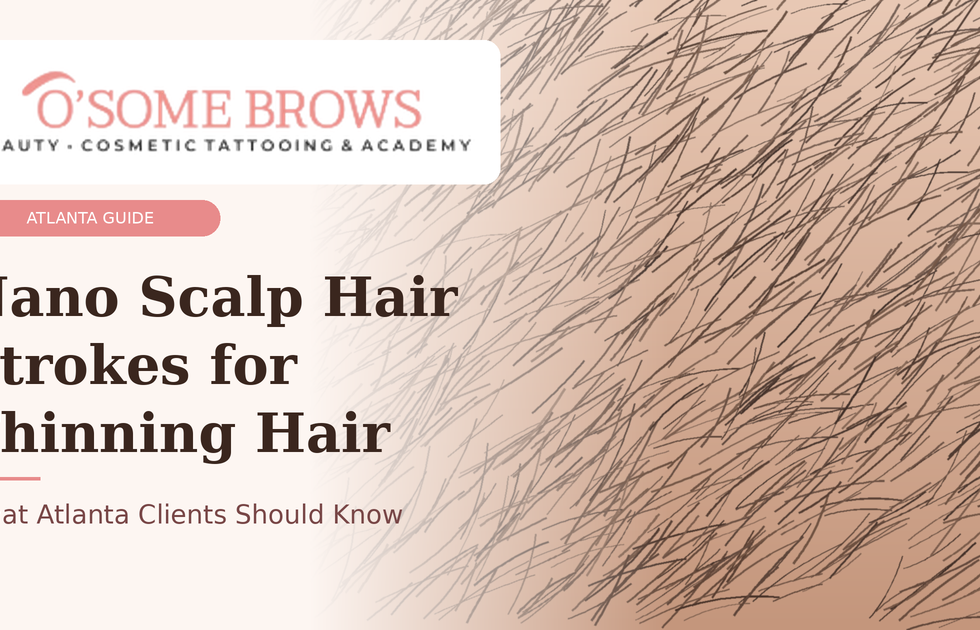
Nano Scalp Hair Strokes are a cosmetic tattoo technique used to create the appearance of individual strands of hair on areas of the scalp where natural hair has become sparse.
A fine digital device is used to deposit pigment into the skin in carefully placed, hair-like strokes. These strokes are designed to blend with the client’s existing hair and reduce the visual contrast between the hair and exposed scalp.
One thing should be clear from the beginning: the treatment does not grow new hair.
Instead, it creates the visual impression of greater density.
O’Some Brows offers Nano Scalp Hair Strokes for both men and women experiencing concerns such as thinning hair and receding hairlines.
How Can It Make Thinning Hair Look Fuller?
When hair begins thinning, the scalp underneath becomes more visible. That contrast is often what makes thinning areas stand out.
Nano Scalp Hair Strokes add fine lines of pigment within those areas. When the pigment color, stroke direction and placement work with your existing hair, there is less obvious empty space between the strands.
Imagine looking at a drawing made with ten lines compared with the same drawing containing twenty. Nothing physically became thicker, but visually, the space looks fuller.
That’s essentially the principle behind the treatment.
Who Might Consider Nano Scalp Hair Strokes?
Hair thinning doesn’t follow one pattern, so the treatment isn’t limited to one type of client.
It may be considered by people dealing with:
- A thinning hairline
- Sparse areas around the scalp
- A widening part
- Receding areas near the temples
- Reduced visual hair density
- Certain visible scalp scars
Both men and women may explore the treatment.
However, suitability depends on your individual scalp, existing hair and the type of thinning you’re experiencing. A consultation is important before assuming that the treatment will work for your situation.
Nano Hair Strokes vs. Traditional Scalp Micropigmentation
The terms can get confusing.
Traditional scalp micropigmentation, often shortened to SMP, typically uses tiny pigment impressions to imitate the appearance of hair follicles. It is frequently associated with the look of a closely shaved head.
Nano Scalp Hair Strokes take a different visual approach.
Instead of primarily recreating dots or follicles, the artist creates fine strokes that resemble strands of hair. This can make the technique particularly interesting for clients who still have natural hair and want the pigment to blend into thinner sections.
Neither approach is automatically better. They create different visual effects.
What Happens During a Consultation?
This is where expectations should become specific.
Your artist needs to look at the area rather than simply hear, “My hair is thinning.”
Where is the thinning happening? How much natural hair remains? Which direction does it grow? What is your natural hair color? How visible is your scalp?
All of these details influence the treatment plan.
The artist can then discuss pigment selection, stroke placement and how much density may realistically be created.
Bring photographs of how you normally style your hair if necessary. Your scalp may look completely different when your hair is parted naturally compared with when it’s pushed away for an examination.
What Happens During the Procedure?
Once the treatment area and design have been established, the artist uses a precision device to place pigment into the scalp.
The strokes need to follow the direction and pattern of the surrounding natural hair. This is what prevents the treated area from looking like a random collection of identical lines.
Treatment time can vary considerably depending on the size of the area being addressed.
A small section near the hairline obviously requires a different amount of work than a larger area across the scalp.
You may also need more than one session to gradually build the desired appearance.
Will Nano Scalp Hair Strokes Look Fake?
They shouldn’t look like someone drew lines on your scalp.
Natural-looking results depend heavily on technique. Real hair doesn’t grow in perfectly identical strokes at perfectly equal distances. An artist needs to consider variations in direction, density, length and placement.
Pigment choice matters too.
Too dark, and the strokes can stand out. Too light, and they may not create enough visual density.
This is why reviewing an artist’s previous work—especially healed results—is useful before choosing a provider.
What Is Healing Like?
Your scalp needs time to recover after the procedure.
The treated area may initially appear stronger or darker because the pigment is fresh. As the skin heals, the appearance should soften.
Your artist will provide specific aftercare instructions. Follow them carefully, particularly when it comes to washing the area, using hair or skincare products, sun exposure, sweating and touching the treated skin.
Don’t scratch or pick at the area while it heals, even if you notice dryness or flaking.
Trying to “help” healing along can do exactly the opposite.
How Long Do Nano Scalp Hair Strokes Last?
Nano Scalp Hair Strokes are considered semi-permanent.
The pigment gradually fades over time rather than remaining unchanged forever. How quickly that happens depends on several factors, including your skin, lifestyle, sun exposure and aftercare.
Touch-ups or refresh sessions may eventually be needed to maintain the desired appearance.
For some clients, gradual fading is actually useful. Hairlines and hairstyles change over time, so a semi-permanent treatment can be refreshed and adjusted rather than remaining identical indefinitely.
Can Nano Scalp Hair Strokes Stop Hair Loss?
No.
This treatment changes the appearance of thinning hair. It doesn’t treat the biological or medical reason your hair is thinning.
Hair loss can have many causes. If you’ve experienced sudden, unexplained or significant hair loss, speak with an appropriate healthcare professional before treating it purely as a cosmetic concern.
Nano Scalp Hair Strokes can help disguise certain visible effects of thinning, but they aren’t a medical hair-loss treatment.
How Are They Different From a Hair Transplant?
A hair transplant involves surgically relocating actual hair follicles to areas affected by hair loss.
Nano Scalp Hair Strokes don’t relocate follicles or create new hair. Pigment is used to imitate the visual appearance of strands within thinning areas.
That makes it a very different type of treatment.
Someone looking for actual hair restoration should discuss medical or surgical options with an appropriately qualified provider. Someone mainly interested in reducing the appearance of visible scalp may find a cosmetic approach worth exploring.
Choosing Nano Scalp Hair Strokes in Atlanta
Scalp work requires a good eye for detail.
When researching Nano Scalp Hair Strokes Atlanta, don’t judge an artist only by how dark or full the immediate result appears. Look for work that blends naturally with the client’s existing hair.
O’Some Brows offers Nano Scalp Hair Strokes among its cosmetic services and currently serves the Atlanta area through locations in Marietta, Lawrenceville, and Johns Creek Town Center in Suwanee, Georgia.
A consultation is the right starting point because scalp coverage isn’t a one-size-fits-all treatment.
Fuller-Looking Doesn’t Have to Mean More Hair
That’s ultimately what makes Nano Scalp Hair Strokes interesting.
The treatment isn’t promising to replace hair you’ve lost. It’s working with what you still have and reducing the visual impact of the areas where your scalp has become more noticeable.
For the right client, that may be enough.
If you’re considering Nano Scalp Hair Strokes Atlanta, focus on realistic expectations. Ask what can be achieved with your existing density, understand how many sessions may be needed and give the treatment time to heal before judging the final effect.
The goal isn’t to create a completely different head of hair.
It’s to make thinning a little less obvious.
Frequently Asked Questions
1. Do Nano Scalp Hair Strokes grow new hair?
No. Nano Scalp Hair Strokes are a cosmetic treatment. Pigment is used to imitate fine strands of hair and create the appearance of greater density. The procedure doesn’t stimulate new hair growth.
2. Can women get Nano Scalp Hair Strokes?
Yes. The treatment can be used for both men and women. Suitability depends on the pattern of thinning, existing hair and condition of the scalp.
3. How many Nano Scalp Hair Stroke sessions will I need?
There isn’t one number that applies to everyone. The size of the treatment area, existing hair density and desired result can influence how many sessions are appropriate. Your artist can provide a more specific plan after examining your scalp.
4. Are Nano Scalp Hair Strokes permanent?
They are semi-permanent. The pigment gradually fades, and refresh sessions may be needed over time. Factors such as sun exposure, skin characteristics, lifestyle and aftercare can affect how long the result remains visible.
5. Where can I get Nano Scalp Hair Strokes near Atlanta?
O’Some Brows offers Nano Scalp Hair Strokes and currently lists Atlanta-area locations in Marietta, Lawrenceville, and Johns Creek Town Center in Suwanee, Georgia. A consultation can determine whether the treatment is suitable for your particular type of hair thinning.